Free guideEight pages

Why the Healers of Today Need a Different Roadmap

Chronic, complex illness has gone from 6% of people to 60% since the 1930s, and it is still climbing. Whatever we are doing, it is not working the way it should.

I did not find the answer in a textbook. I found it over 43 years in practice, with thousands of patients who had tried everything and were still not well.

This guide is the map I built instead: six shifts in thinking that changed how I diagnose, how I treat, and what I believe is possible.

A few quick questions, then the guide opens and a copy is emailed to you.

6→60%of people now live with chronic, complex illness
86%of health care spending goes to treating it
70/30of cellular energy from light, water and magnetism, vs. food
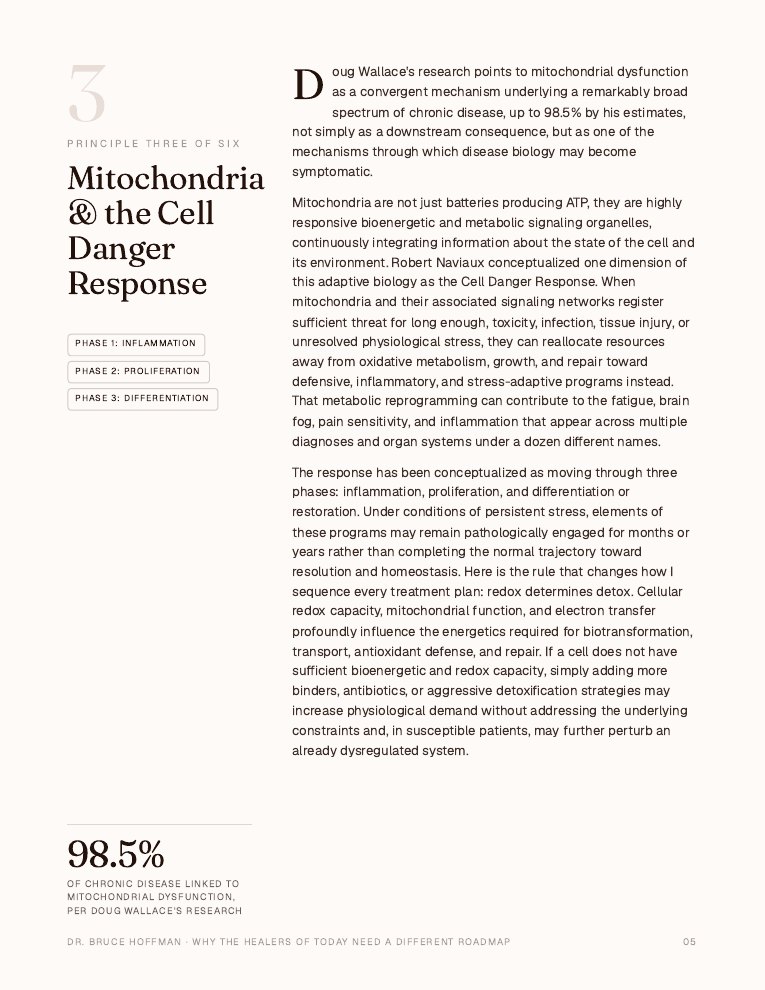
98.5%of chronic disease linked to mitochondria (Wallace)
Before the six principles

The map is too limited

The percentage of people living with chronic complex health conditions has risen exponentially from 6% in the 1930s, to 60% today, and it's still climbing. 86% of health care spending in North America now goes toward treating chronic complex illness. Nearly three in four adults are overweight or obese and young adult cancer rates have surged over the last decade. A 2023 CDC study showed life expectancy falling for the second year running. Whatever we are doing, it is not working the way it should.

I did not arrive at the six principles in this guide from a textbook, and they are not medical board doctrine. I arrived at them after 43 years of clinical practice, roughly 300 medical conferences, and thousands of patients who had already tried everything the conventional system in which I had initially been trained had to offer and were still not well.

The old paradigm is not wrong. It is simply too small for the complexity of the people sitting in the room with us. What follows is the outline of what I built to make it more expansive: six shifts in thinking that changed how I diagnose, how I treat, and what I believe is possible for a person who has been told there is nothing wrong with them, or nothing more that can be done.

“When all you have is a hammer, everything looks like a nail.”

The six principles

Six shifts in thinking. Each gets a page of its own in the guide, in my own words, with the research behind it. Here is the shape of them.

Principle 01

Expand the Diagnostic Model

Most of my training taught me to look through one layer: the physical body. I built a model with seven, each with its own history to take, its own labs and its own treatments.

The seven layers
  • 01

    The environment

  • 02

    The physical body

  • 03

    The electromagnetic body

  • 04

    The emotional body

  • 05

    The intellectual body

  • 06

    The soul

  • 07

    The spirit

Principle 02

Biophysics Directs Biochemistry

I was trained to think in molecules. But chemistry happens inside physics: light, water and electrical gradients set the conditions under which the biochemistry can occur at all.

What sets the conditions
  • Light

  • Water

  • Electrical gradients

  • Electromagnetic forces

  • Biological information

  • 70/30

    Electron flow: light, water and magnetism vs. food

Principle 03

Mitochondria & the Cell Danger Response

Mitochondria are not just batteries. They sense danger, and when the threat lasts long enough they switch the whole cell into defence. The rule that changes every treatment plan: redox determines detox.

The Cell Danger Response
  • 1

    Inflammation

  • 2

    Proliferation

  • 3

    Differentiation, or restoration

  • Rule

    Redox determines detox

Principle 04

Five Possibilities for Health

Ask most people what health means and they describe the absence of a problem. I think of it as a continuum, from symptom relief to a genuine shift in who we take ourselves to be.

The continuum
  • 1

    Symptom relief

  • 2

    Symptoms as information

  • 3

    Wellbeing itself: salutogenesis

  • 4

    From role to soul, hero to elder

  • 5

    A shift in consciousness

Principle 05

Foundational Health Cycle Principles Before Interventions

We all reach for the sophisticated tool before the foundation can hold any weight. Light, rhythm, breath, food, sleep and a regulated nervous system come first, and alongside everything else.

The foundation first
  • Light and circadian rhythm

  • A low-EMF home, especially at night

  • Grounding and breath

  • Hydration and real food

  • Sleep

  • Nervous system regulation

  • Then

    Advanced interventions, once the foundation holds

Principle 06

Reframe the Doctor–Patient Relationship: Hero to Healer

When a diagnosis cannot be named, it is tempting to conclude there is nothing wrong. The shift is from the doctor as the hero with the answer to the doctor as a relational healer.

What changes in the room
  • The patient's observations are clinical data

  • One to three hours to reconstruct the chronology

  • Antecedents, triggers, mediators, perpetuating factors

  • The humility to say: I have reached the limit of what I know

Get the free guide

Inside the guide

Eight pages, written to be read in one sitting and kept. It opens on screen the moment you finish the questions, and a copy arrives by email so you can print it or pass it on.

  • Before the six principles The map is too limited, in numbers.
  • Principles one to six A page each: the idea, the research, and what it changed in my own practice.
  • In closing Where this leaves us, and a letter from me.

Get the free guide

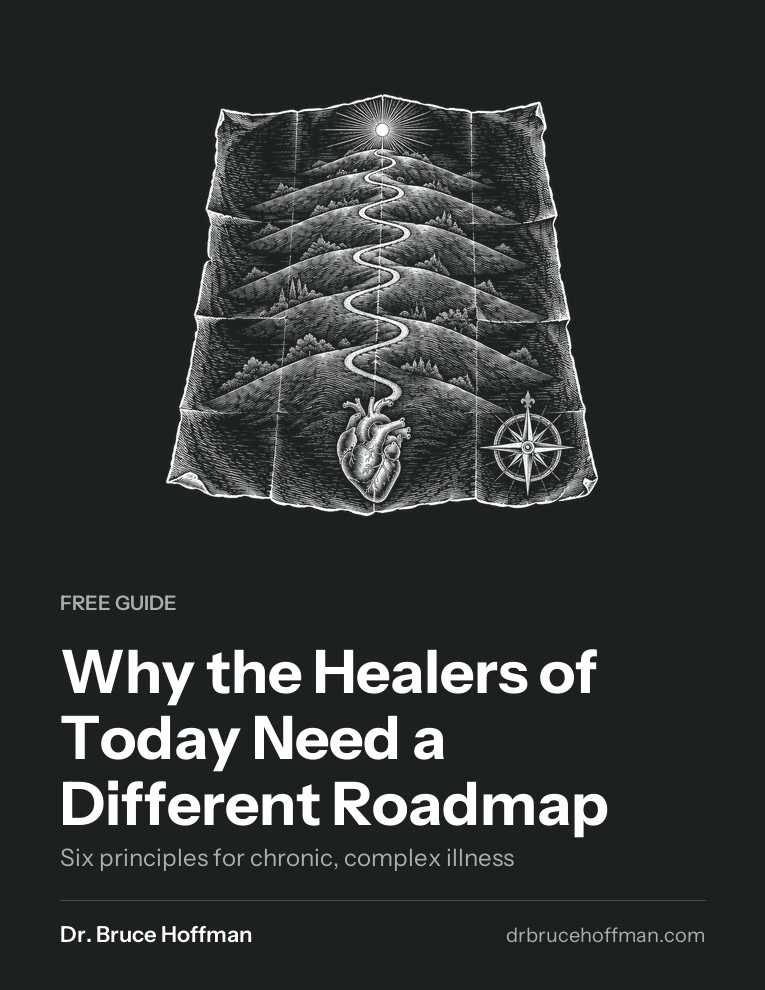
The guide's coverA page from the guide: principle three, mitochondria and the Cell Danger Response
Dr. Bruce Hoffman

A word from Dr. Hoffman

I did not arrive at this way of thinking in a classroom.

I arrived at it through the repeated experience of meeting people whose illnesses exceeded the explanatory and therapeutic reach of the models I had been trained in. When the existing framework repeatedly fails to account for what is standing in front of you, the responsible response is not to dismiss the person. It is to examine the limits of the framework.

If this way of thinking about chronic illness resonates with you, stay close. I write regularly about precisely this intersection: where conventional medical knowledge meets the broader biological, biophysical, psychological and relational dimensions of what it means to become ill, and what it may take to become well again.

Yours in health,
Dr. Bruce Hoffman
43 years in clinical practice · Integrative and functional medicine

Questions

Is the guide really free?

Yes. You answer a few short questions about who you are and what you are interested in, then the guide opens straight away and a copy is emailed to you.

Who is it for?

Anyone called to heal: doctors, nurses, naturopaths, coaches, therapists, bodyworkers, and people who have become the healer in their own family. No medical degree needed to read it.

What is in it?

Eight pages: why the current map is too limited, the six principles with a page each, and a closing letter. The research is named where it is used (Naviaux, Wallace, Antonovsky and others).

How does this relate to the 7 Stages?

It is the thinking underneath it. The Roadmap for the Modern Healer teaches the whole model over ten weeks. This guide is where to start, and it is free.

Is this medical advice?

No. It is education, drawn from Dr. Hoffman's clinical experience and the research he cites. Talk to your own practitioner before you change any treatment.

The old map is not wrong. It is too small.

Six principles for the healers of today. Free, eight pages.

Get the free guide
Why the Healers of Today Need a Different Roadmap Free guide, eight pages
Get the free guide