

Topic hub
Mold illness & CIRS
What mold and other biotoxins do to a susceptible body, how Dr. Hoffman investigates exposure, how a home is tested and remediated, and the order treatment has to follow, including the Shoemaker protocol.

Start here
 Mold & CIRS
Mold Illness and CIRS: Symptoms, Misconceptions, Treatment
Mold illness, or CIRS, causes symptoms from brain fog to fatigue. Learn 13 CIRS mold symptoms, 4 misconceptions and Dr. Hoffman's treatment steps.
 Mold & CIRS
What Is CIRS? Meaning, Symptoms, Criteria and Treatment
CIRS meaning explained: Shoemaker diagnostic criteria, the 37 symptoms, HLA gene testing, biomarkers like MSH, C4a and TGF beta-1, and treatment steps.
 Mold & CIRS
Shoemaker Protocol: The 12 Steps for Mold Illness and CIRS
The Shoemaker protocol for CIRS and mold illness in 12 steps: ERMI and HERTSMI-2 testing, cholestyramine dosing, MARCONS, lab corrections and VIP spray.
In Dr. Hoffman’s words
What mold illness is
Mold illness is better described as chronic inflammatory response syndrome (CIRS), first described by Dr. Ritchie Shoemaker in the late 1990s. It is an inflammatory response to biotoxins, most often from water-damaged buildings: fungi with their mycotoxins, bacteria with endotoxins, actinomycetes, mycobacteria, beta glucans and volatile organic compounds. Mold accounts for about 80 percent of the CIRS illness burden; Lyme disease, dinoflagellates such as ciguatera, freshwater cyanobacteria and recluse spider bites account for the rest. Mycotoxins are extremely small, fat-soluble molecules that pass straight through cell membranes, which makes them very hard for the immune system to identify.
Why some people get sick and others do not
About 75 percent of people have an immune system that recognises and clears these toxins. Those with particular HLA genes cannot identify them, so they cannot eliminate them, and the innate immune system keeps producing inflammation that can reach every organ. It has been estimated that about 25 percent of people are susceptible; in my experience it is more than that. Not everyone exposed develops CIRS, and some only get allergy-type symptoms. Mold allergy is an IgE antibody response to spores. CIRS is chronic innate immune activation with downstream effects on hormones, so a negative mold IgE does not rule it out.
The symptoms
Headaches, brain fog and memory problems, fatigue, muscle and joint pain, numbness and tingling, light sensitivity, asthma and sinus trouble, vertigo, a metallic taste, night sweats, excessive thirst and urination, appetite changes and abdominal pain. Dr. Shoemaker has identified 37 symptoms in all, grouped into clusters, and because they seem unrelated many people endure years of misdiagnosis or are told the illness is psychosomatic.
How I investigate exposure
I work in layers. First the CIRS symptom questionnaire: more than eight symptoms in more than six of the subtypes puts mold in the differential. Then the visual contrast sensitivity (VCS) test, which about 92 percent of people with CIRS fail. Then the exposure itself: the history, a proper home inspection and ERMI testing. Then the Shoemaker labs: HLA genes, MSH, C4a, TGF beta-1, MMP-9, VEGF, ADH and osmolality, and a deep nasal swab for MARCoNS. A urine mycotoxin test cannot make the diagnosis: many healthy controls have mycotoxins in their urine, foods such as oats, corn and peanuts contain them, and the test cannot show when the exposure happened.
Testing and fixing the building
The best test of a building is the ERMI, a quantitative PCR analysis of 36 mold species in dust, or its shorter five-species version, HERTSMI-2, where a score of 10 or less is the cutoff for someone previously sickened. Air sampling is not a substitute: over 99 percent of the particles that carry inflammagens are smaller than 3 microns, and spore traps only detect particles larger than that. A good inspector works from attic to basement with an infrared camera or moisture meter. Remediation means correcting every source of water entry, replacing moldy wood, drywall and wet carpet rather than cleaning them, HEPA vacuuming and cleaning everything that remains, keeping indoor humidity below 50 percent, and filtering the air down to 0.1 microns. When the mold is affecting your health, the only real alternative is moving.
Treatment, in order
The Shoemaker protocol follows a fixed sequence: remove the exposure, bind the biotoxins with cholestyramine or Welchol, clear MARCoNS with BEG nasal spray, then correct anti-gliadin antibodies, androgens, ADH and osmolality, MMP-9, VEGF, C3a, C4a and TGF beta-1, with VIP nasal spray last, only once exposure has ended, VCS is normal and MARCoNS is gone. In the complex patient I do not reach for cholestyramine first. When total lipid content on the red cell membrane test is low it can crash the patient, so cell membrane repair comes before binders; I screen for POTS and mast cell activation; and I establish trust and self-regulation first, because someone stuck in fight-or-flight cannot tolerate a complex protocol. CIRS is an innate immune response, not chemical toxicity, so detoxification and chelation on their own will not resolve it.
On the evidence
The 2002 ACOEM and 2006 AAAAI guidelines, which stated that mold exposure could not cause human illness, rested largely on opinion papers by consultants in water-damaged building litigation and cited no human studies. There are no long-term randomised trials of the Shoemaker approach, so it has not met Level I criteria, but it is patient-centred and documents quantifiable, reproducible responses to care, which is where evidence-based medicine is supposed to begin.
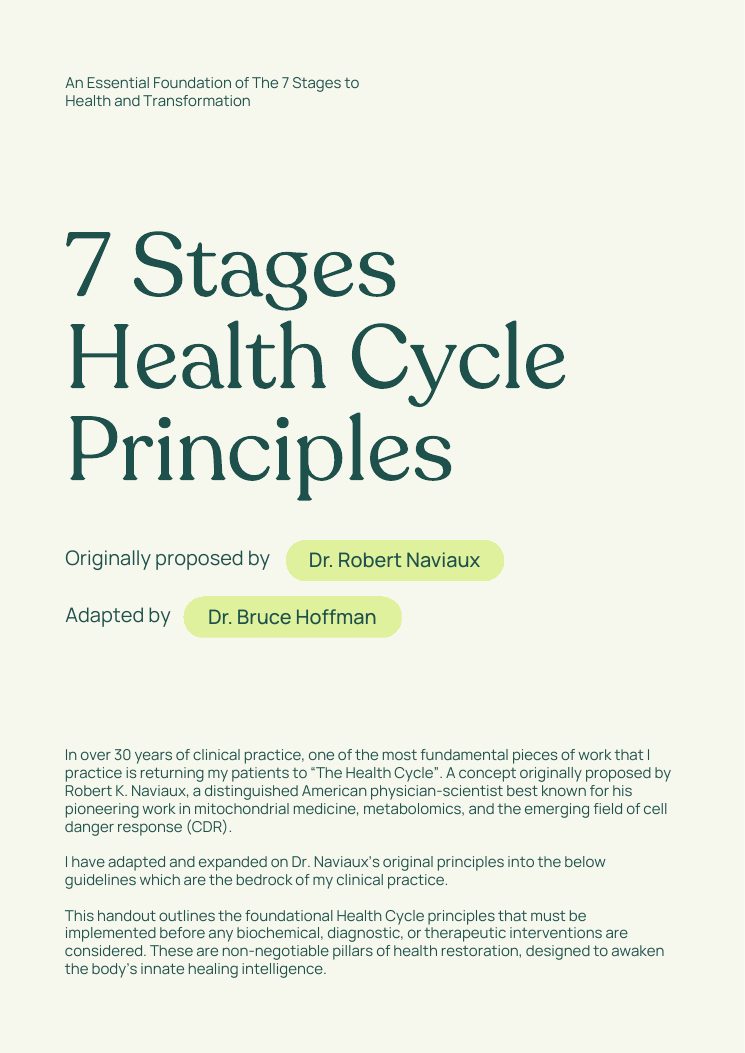
Free guide: the 22 Health Cycle Principles
The everyday foundations Dr. Hoffman puts in place before any treatment: light, sleep, food timing, water, movement and self-regulation. Web page and PDF.
Get the free guideAll 8 articles on Mold illness
- Mold & CIRS
Mold Illness and CIRS: Symptoms, Misconceptions, Treatment
Mold illness, or CIRS, causes symptoms from brain fog to fatigue. Learn 13 CIRS mold symptoms, 4 misconceptions and Dr. Hoffman's treatment steps.
- Mold & CIRS
What Is CIRS? Meaning, Symptoms, Criteria and Treatment
CIRS meaning explained: Shoemaker diagnostic criteria, the 37 symptoms, HLA gene testing, biomarkers like MSH, C4a and TGF beta-1, and treatment steps.
- Mold & CIRS
Shoemaker Protocol: The 12 Steps for Mold Illness and CIRS
The Shoemaker protocol for CIRS and mold illness in 12 steps: ERMI and HERTSMI-2 testing, cholestyramine dosing, MARCONS, lab corrections and VIP spray.
 Mold & CIRS
ERMI Test and CIRS: How to Investigate Mold Exposure
The ERMI test measures mold spores in home dust. Dr. Bruce Hoffman explains it alongside the CIRS symptoms questionnaire, VCS test and Shoemaker labs.
 Mold & CIRS
Household Mold Remediation: Identifying and Removing Mold
Household mold remediation step by step: ERMI and HERTSMI-2 testing, choosing a mold inspector, HEPA vacuuming, cleaning belongings and prevention.
 Mold & CIRS
Frequently Asked Mold Questions: Cleaning After Mold
Answers to frequently asked mold questions: cleaning books, electronics, leather and dishes, HEPA vacuum filters, cars, friends' homes and ERMI testing.
 Mold & CIRS
Biotoxin Illness Treatment: Pitfalls in Mold and CIRS Care
Biotoxin illness treatment in mold and CIRS: why a urine mycotoxin test cannot diagnose it, when cholestyramine harms, and what to assess first.
 Mold & CIRS
CIRS Shoemaker Protocol Evidence and Randomized Trials
Is there randomized trial evidence for the Shoemaker CIRS protocol and cholestyramine in mold illness? How evidence-based medicine and its flaws apply.
Frequently asked questions
Other topic hubs
- Topic hub
The 7 Stages to Health & Transformation
Why one diagnosis and one protocol are not enough for complex chronic illness, and the seven-level map Dr. Hoffman uses to decide what to treat first: environment, biochemistry, the electromagnetic body, emotion, belief, family systems and meaning.
- Topic hub
MCAS & POTS
Everything Dr. Hoffman has written on mast cell activation syndrome, histamine and POTS: what it is, how it is tested, what triggers it and how it is treated, from the co-author of the global MCAS consensus-2 paper.
- Topic hub
Mitochondria & the cell danger response
Why so much chronic illness comes back to cells stuck in defence mode, and what Dr. Hoffman does about it: membranes and fats first, then light, timing, food and movement.
Dr. Bruce Hoffman
MSc, MBChB, FAARM, IFMCP · Integrative and functional medicine physician and educator
Over 30 years with complex chronic illness: MCAS, POTS, mold illness (CIRS), Lyme disease, the cell danger response and mitochondrial medicine. Creator of the 7 Stages to Health & Transformation and co-author of the global MCAS “consensus-2” paper with Dr. Afrin’s group. He now teaches online. This page is education, not medical advice.
