

Topic hub
Mitochondria & the cell danger response
Why so much chronic illness comes back to cells stuck in defence mode, and what Dr. Hoffman does about it: membranes and fats first, then light, timing, food and movement.

Start here
 Longevity
Cell Danger Response Treatment: Phospholipids and Butyrate
Dr. Bruce Hoffman on cell danger response treatment: IGL mitochondrial testing, fatty acid panels, and supplements such as phospholipids and butyrate.
 Diet & Recipes
Food as Light Information: Why Seasonal, Local Eating Is Mitochondrial Medicine
Food is not just fuel, it is structured sunlight your mitochondria are built to read. Dr. Bruce Hoffman on biophotons, mTOR and AMPK, and why diets that should work often don't until light, timing and season line up.
 Diet & Recipes
The Fat Paradox: Omega-6 Deficiency, Not Seed Oils, Is the Problem
The war on seed oils has it backwards. Most chronically ill patients are omega-6 deficient and over-supplemented with omega-3. Dr. Bruce Hoffman on membranes, the 4:1 ratio, and how to choose and test essential fats.
In Dr. Hoffman’s words
The cell danger response
Drawing on Dr. Robert Naviaux’s work: under a perceived or real threat, mitochondria stop making energy for the cell, begin to self-destruct and release ATP outside the cell. That sets off an inflammatory cascade that oxidises cell membranes and leads to innate immune and mast cell activation. Much of what gets called adrenal fatigue sits inside this. I measure cortisol, but I see the HPA axis as secondary, one part of a wider cascade of mitochondrial shutdown driven by mold, infections, hormones, early trauma and belief systems, and once the allostatic load comes down the cortisol measures tend to correct themselves. The mitochondrion is not just an ATP factory; it is a quantum-sensitive sensor of environmental coherence.
How I assess it
Two tests do most of the work. The IGL mitochondrial blood test covers about 300 parameters: mitochondrial numbers, ATP production and blockage, cell-free DNA, DNA adducts, phosphatidylcholine, phosphatidylethanolamine, cardiolipin, fungal and mycotoxin metabolites, antioxidant enzymes and cell membrane voltage. The red cell fatty acid panel from the Kennedy Krieger Institute shows what the membranes are built from. And before any of it, a ten-minute lying-and-standing test for POTS, because a patient who does not perfuse the brain and the mitochondria will not improve until that is treated.
Membranes first
I begin with oral and intravenous phospholipid therapy, not with detoxification or infection treatment, to move the mitochondria toward a healing response, and add butyrate later. In my experience it takes about six months to a year to get the mitochondria repaired. Which fats matters. There is a war on seed oils, but in practice most chronically ill patients are not overloaded with omega-6; they are deficient in it and over-supplemented with omega-3, which reverses the roughly 4:1 omega-6 to omega-3 ratio healthy membranes are built on. Linoleic acid, GLA and arachidonic acid are the raw material of phosphatidylcholine. The problem with industrial seed oils is the processing, refined, bleached, deodorised and heat-extracted, not the omega-6 itself. Eat the fish rather than the capsules, choose cold-pressed unrefined oils, and test fatty acids rather than guessing; sensitive patients are introduced to clean omega-6s slowly. My power shake is a template built around that testing, never a fixed recipe.
NAD+
NAD+ is a coenzyme found in every cell. It carries the electrons that let the Krebs cycle and the electron transport chain turn food into ATP, it is needed for DNA repair, and it activates the sirtuins, including SIRT1, which are linked to longevity. Levels decline with age, and low NAD+ goes with accelerated ageing, inflammation, weaker immunity and poorer brain function. Exercise, ketosis, intermittent fasting, calorie restriction and vitamin B3 foods all raise it. NAD+ taken by mouth breaks down in the gut, so oral preparations use a precursor such as nicotinamide riboside.
Light, water, then food
Food is not just fuel; it is structured sunlight. All living cells emit ultra-weak coherent light, biophotons, and fresh, seasonal food carries more of it than processed or long-stored food. Mitochondria decode the electrons and photons in what you eat, so food grown under your own sun matches your light environment, while tropical fruit in a Canadian December scrambles the signal. Summer light and summer carbohydrates drive mTOR, growth and storage; short winter days and cold drive AMPK, fat burning, repair and mitochondrial biogenesis. Mismatching them drives inflammation and leptin resistance. In my sequence light comes first, then water and circadian timing, then diet, which is why patients with chronic fatigue, MCAS or CIRS often fail on a perfect diet until morning light, meal timing and cold exposure are addressed too. The solar callus guide is the practical start: melanin built gradually, without ever burning.
Ketones, fasting and movement
Ketones cross the blood-brain barrier without transport proteins, can supply up to 75 percent of the brain’s energy, improve mitochondrial ATP production and suppress the NLRP3 inflammasome, which is why a modified ketogenic diet is the backbone of the neuroprotective approach I use. Fasting and exercise are not optional: twelve hours overnight, sixteen for APOE4 carriers, aerobic work combined with weights, and supper no later than 6 pm. Protein at 1 to 1.25 grams per pound of lean body weight, and plenty of water with mineral-rich salt, especially with POTS.
Where to go from here
The 22 Health Cycle principles are the everyday practices that support mitochondrial function, circadian and seasonal harmony and stress regulation; they come before any supplement. A focused micro-course on the cell danger response and mitochondrial disorders is in development.
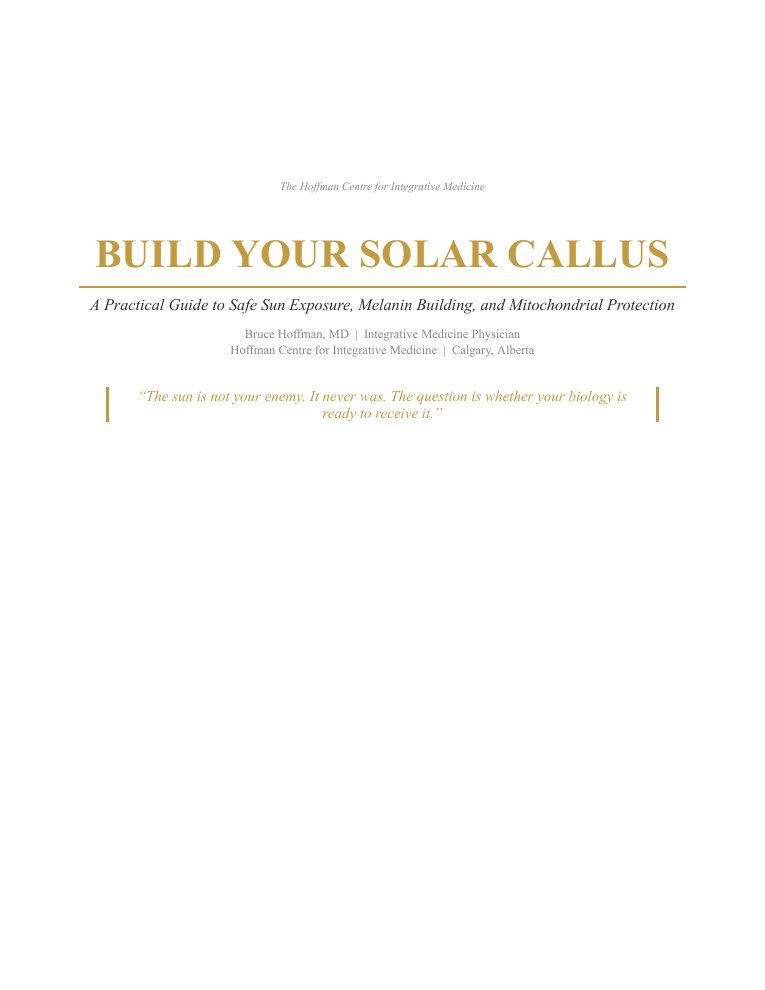
Free guide: Build Your Solar Callus
Safe sun exposure: how to build melanin gradually without ever burning, and why light, food and grounding all play a part in protecting your mitochondria. 7 pages, PDF.
Get the free guide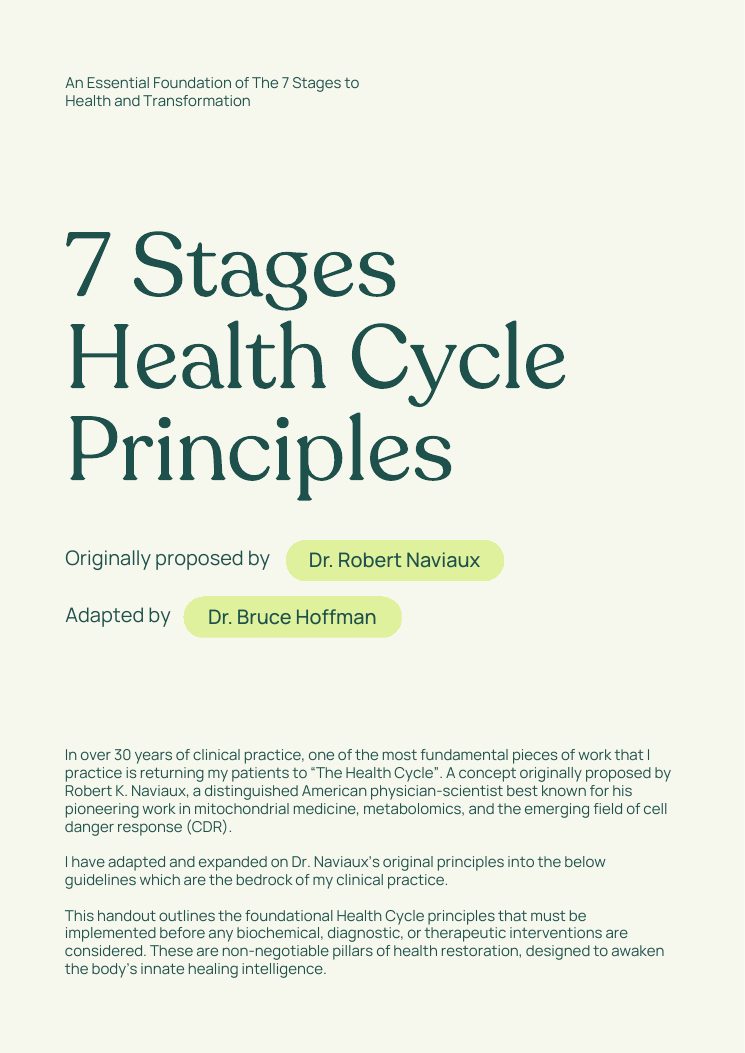
Free guide: the 22 Health Cycle Principles
The everyday practices that support mitochondrial function and circadian rhythm, adapted from Dr. Robert Naviaux. Web page and PDF.
Get the free guideAll 8 articles on Mitochondria
- Longevity
Cell Danger Response Treatment: Phospholipids and Butyrate
Dr. Bruce Hoffman on cell danger response treatment: IGL mitochondrial testing, fatty acid panels, and supplements such as phospholipids and butyrate.
- Diet & Recipes
Food as Light Information: Why Seasonal, Local Eating Is Mitochondrial Medicine
Food is not just fuel, it is structured sunlight your mitochondria are built to read. Dr. Bruce Hoffman on biophotons, mTOR and AMPK, and why diets that should work often don't until light, timing and season line up.
- Diet & Recipes
The Fat Paradox: Omega-6 Deficiency, Not Seed Oils, Is the Problem
The war on seed oils has it backwards. Most chronically ill patients are omega-6 deficient and over-supplemented with omega-3. Dr. Bruce Hoffman on membranes, the 4:1 ratio, and how to choose and test essential fats.
 Chronic Fatigue
Mitochondria and Adrenal Fatigue: Dr. Bruce Hoffman
Dr. Bruce Hoffman explains why adrenal fatigue follows mitochondrial shutdown and the cell danger response, plus mast cells, histamine and fatty acids.
 Longevity
NAD Supplement Benefits: What NAD+ Does and How to Raise It
NAD+ benefits explained: what an NAD supplement is, how NAD+ drives energy, DNA repair and sirtuins, and natural ways to raise NAD+ as you age.
 Diet & Recipes
Medical Ketogenic Diet Food List for Neuroprotection
A medical ketogenic diet food list for neuroprotection: which vegetables, proteins and fats to eat or avoid, macros, fasting and keto basics for beginners.
 Diet & Recipes
Practical Tips on Exercise and Diet from Dr. Bruce Hoffman
Dr. Bruce Hoffman's exercise and diet tips: daily workouts, mineral salt and hydration, 1 to 1.25 g protein per pound lean weight, conscious eating.
 Diet & Recipes
Power Shake Ingredients: A Fatty Acid Recipe Template
Power shake ingredients in Dr. Hoffman's fatty acid template: coconut milk, balanced oils and minerals, adjusted by testing, plus Bulletproof coffee.
Frequently asked questions
Other topic hubs
- Topic hub
The 7 Stages to Health & Transformation
Why one diagnosis and one protocol are not enough for complex chronic illness, and the seven-level map Dr. Hoffman uses to decide what to treat first: environment, biochemistry, the electromagnetic body, emotion, belief, family systems and meaning.
- Topic hub
MCAS & POTS
Everything Dr. Hoffman has written on mast cell activation syndrome, histamine and POTS: what it is, how it is tested, what triggers it and how it is treated, from the co-author of the global MCAS consensus-2 paper.
- Topic hub
Mold illness & CIRS
What mold and other biotoxins do to a susceptible body, how Dr. Hoffman investigates exposure, how a home is tested and remediated, and the order treatment has to follow, including the Shoemaker protocol.
Dr. Bruce Hoffman
MSc, MBChB, FAARM, IFMCP · Integrative and functional medicine physician and educator
Over 30 years with complex chronic illness: MCAS, POTS, mold illness (CIRS), Lyme disease, the cell danger response and mitochondrial medicine. Creator of the 7 Stages to Health & Transformation and co-author of the global MCAS “consensus-2” paper with Dr. Afrin’s group. He now teaches online. This page is education, not medical advice.
