

Topic hub
The 7 Stages to Health & Transformation
Why one diagnosis and one protocol are not enough for complex chronic illness, and the seven-level map Dr. Hoffman uses to decide what to treat first: environment, biochemistry, the electromagnetic body, emotion, belief, family systems and meaning.

Start here
 General
Is Functional Medicine Dead? Why It Plateaued and What Comes Next
Functional medicine fixed what allopathic medicine missed, then stalled: it still treats the body as chemistry. Dr. Bruce Hoffman on why chronic illness outgrew it, and the seven-layer model that comes next.
 General
Seven Stages to Health: Klinghardt's Five Levels Expanded
Dr. Hoffman's ISEAI 2020 talk expands Klinghardt's five levels of healing into seven stages for complex illness, from environment to emotions and soul.
 General
Chronic Illness and the Seven Layers of Healing
Dr. Bruce Hoffman tells Judy Cho why chronic illness needs healing at seven levels, from toxins, labs and the cell danger response to trauma and meaning.
In Dr. Hoffman’s words
Why functional medicine plateaued
Functional medicine was a powerful corrective to the allopathic model. Where traditional medicine relied on N2D2, name of disease, name of drug, functional medicine brought upstream thinking, systems biology and root-cause inquiry, and looked at how genetics, environmental toxicity, nutrition and stress act on the gut, the immune system, liver detoxification, hormones and energy production. That was real progress, and it still serves pneumonia well. But it has plateaued, because it remains a chemistry-only model. It still treats the body as a collection of malfunctioning parts, applying supplements instead of pharmaceuticals, still thinking in protocols, still thinking linearly. Over 60 percent of people now live with a chronic disease, and conditions like MCAS cross every specialty with no single biomarker or cause.
The seven stages
I adapted the model from Dr. Dietrich Klinghardt’s Five Levels of Healing and the Vedantic koshas, and with his permission made the environment its own stage and separated emotion from intellect. Stage one is the environment: mercury, organophosphates, biotoxins, root canals, tick bites. Stage two is the physical and biochemical body, the functional medicine workup, including the cell danger response, mitochondria and mast cells. Stage three is the electromagnetic body and the autonomic nervous system, assessed with NeuroQuant MRI, QEEG and heart rate variability, and with a building biologist measuring EMFs and dirty electricity at home. Stage four is emotion and early trauma. Stage five is the intellect, the ego and its beliefs and values. Stage six is the soul and the family system, including inherited trauma. Stage seven is spirit, the expanded state of consciousness. Stages one to five belong to the conscious, personal realm; six and seven to the unconscious, systemic and transpersonal.
Higher levels organise lower ones
In this model the higher levels have an organising influence on the lower ones, and resolution at a higher level trickles down. You cannot treat POTS and hope that family-system trauma heals, but if the family-system trauma heals, the POTS may resolve. Symptoms are often teleological: they point toward something in the patient’s system that needs to be made conscious. One of my POTS patients saw her symptom score fall from 102 to 30 after she uncovered an unconscious loyalty to her deceased father, alongside heart-rate-variability training, somatic experiencing and functional medicine care.
How it works in practice
It begins with a long history, two and a half to three hours, and a 70-page questionnaire that first asks what the patient wants and how committed they are. Part of it maps the hierarchy of values, by asking how someone spends their time, money and attention, because when health sits fourth on the list behind business it rarely improves, and motivation from outside lasts about six weeks. I run a ten-minute lying-and-standing test on everybody, because about one in five has POTS and nobody improves until it is under control. And I find early developmental trauma in almost every complex history: adverse childhood experiences carry a three- to four-fold health disadvantage, and children who were not adequately seen do not learn to self-regulate.
Nothing new under the sun
An integrated approach is not a new idea. At the temples of Asclepius in classical Greece, patients began in the outer sanctum with fasting, nutrition, detoxification and massage, the level we now call stage two, then moved to the inner sanctum, took an oath and stayed until a dream, interpreted by the priests, signalled that healing was under way. The Caduceus, with its two snakes, stands for the balance between Knowledge, learned from outside, and Wisdom, which comes from within. Modern medicine has leaned heavily toward Knowledge and neglected Wisdom; true healing needs both.
Before any of it: the Health Cycle
In over 30 years of practice, one of the most fundamental pieces of work I do is returning patients to the Health Cycle, a concept originally proposed by Dr. Robert Naviaux that I have adapted into 22 principles. Relocation away from pollutants, hydration, breathing, a local seasonal diet, good sleep, exercise, avoiding non-native EMF, resetting day and night cycles, grounding, hot and cold therapy, stress regulation and strong social connection, among others. These are the foundations that must be in place before any biochemical, diagnostic or therapeutic intervention is considered. The 7 Stages course is the full curriculum built on top of them, and the reading list is the library behind it.
What the patient can do
Find a practitioner with many tools. Become your own patient advocate. Share responsibility for healing rather than projecting the will to heal onto the practitioner, a lopsided relationship that is almost doomed to fail. And raise health up as a value, because the people who do best are the ones for whom it genuinely comes first.
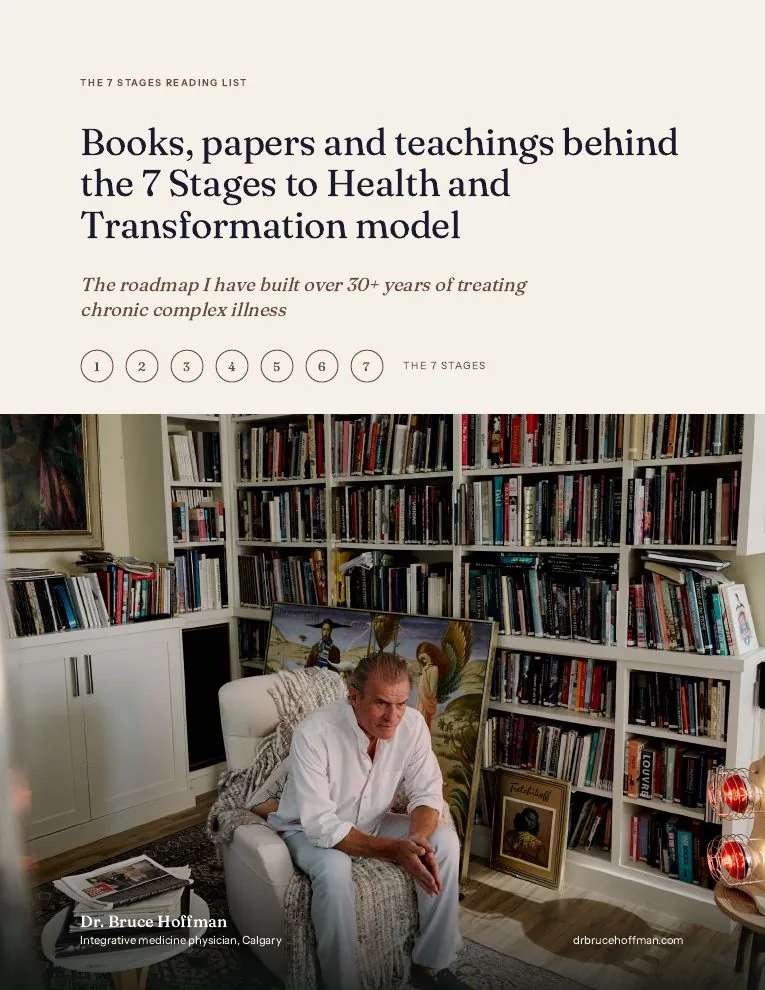
Free guide: the 7 Stages Reading List
The 400+ books, papers and lectures behind the 7 Stages model, organised stage by stage in the order Dr. Hoffman works through a complex case. 24 pages, PDF.
Get the reading list
Free guide: the 22 Health Cycle Principles
The foundations to put in place before any treatment, adapted from Dr. Robert Naviaux's Health Cycle. Web page and PDF.
Get the free guideAll 9 articles on 7 Stages
- General
Is Functional Medicine Dead? Why It Plateaued and What Comes Next
Functional medicine fixed what allopathic medicine missed, then stalled: it still treats the body as chemistry. Dr. Bruce Hoffman on why chronic illness outgrew it, and the seven-layer model that comes next.
- General
Seven Stages to Health: Klinghardt's Five Levels Expanded
Dr. Hoffman's ISEAI 2020 talk expands Klinghardt's five levels of healing into seven stages for complex illness, from environment to emotions and soul.
- General
Chronic Illness and the Seven Layers of Healing
Dr. Bruce Hoffman tells Judy Cho why chronic illness needs healing at seven levels, from toxins, labs and the cell danger response to trauma and meaning.
 General
Chronic Illness Healing: Dr. Bruce Hoffman Interview
Dr. Bruce Hoffman on chronic illness healing: early childhood trauma, family systems, health as a value, and his Seven Stages to Health and Transformation.
 General
Practicing the Medical Arts: A Seven-Level Approach
Dr. Hoffman on Artist Decoded: practicing the medical arts across seven levels, from environment and biochemistry to values, family trauma and soul.
 General
Ancient Healing Techniques from Asclepius to Descartes
Ancient healing practices of the Asclepian temples, Hippocrates, Galen and Paracelsus, and why Dr. Hoffman says inner and outer healing must be balanced.
 General
What Is Functional Medicine? Principles and Approach
Functional medicine is an integrative, science-based approach that weighs genetics, environment, nutrition and stress to treat causes of chronic disease.
 General
Common Household Toxins and How to Reduce Them
Common household toxins like BPA, phthalates, PFOA and pesticides, where toxins in the home hide in air, water and food, and 13 steps to reduce them.
 General
Gas Stove Controversy: Indoor Air and Asthma Risk
The gas stove controversy: nitrogen dioxide, PM2.5 and benzene, what the asthma studies show, their limits, and how to reduce exposure.
Frequently asked questions
Other topic hubs
- Topic hub
MCAS & POTS
Everything Dr. Hoffman has written on mast cell activation syndrome, histamine and POTS: what it is, how it is tested, what triggers it and how it is treated, from the co-author of the global MCAS consensus-2 paper.
- Topic hub
Mitochondria & the cell danger response
Why so much chronic illness comes back to cells stuck in defence mode, and what Dr. Hoffman does about it: membranes and fats first, then light, timing, food and movement.
- Topic hub
Mold illness & CIRS
What mold and other biotoxins do to a susceptible body, how Dr. Hoffman investigates exposure, how a home is tested and remediated, and the order treatment has to follow, including the Shoemaker protocol.
Dr. Bruce Hoffman
MSc, MBChB, FAARM, IFMCP · Integrative and functional medicine physician and educator
Over 30 years with complex chronic illness: MCAS, POTS, mold illness (CIRS), Lyme disease, the cell danger response and mitochondrial medicine. Creator of the 7 Stages to Health & Transformation and co-author of the global MCAS “consensus-2” paper with Dr. Afrin’s group. He now teaches online. This page is education, not medical advice.
